
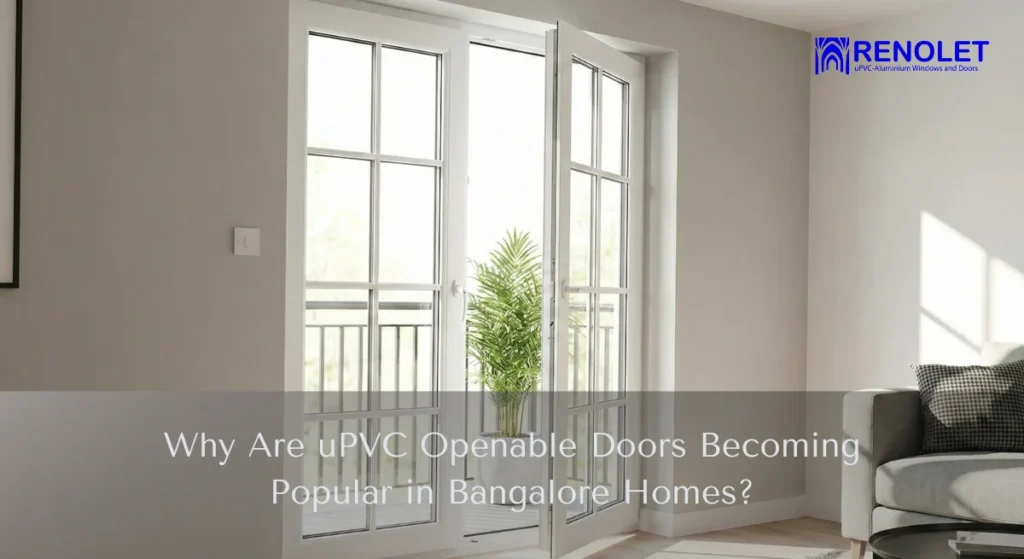
It’s 4 PM in Bangalore. It is a hot afternoon and the sun has been blazing on the balconies and exterior. You are working and all of a sudden, dark clouds come together. After a few minutes, the heavy monsoon rain beats your balcony doors. Wind pressure increases, main road traffic noise increases.
This is where trouble starts in most households – wooden doors swell because of moisture, frames become out of line, water leaks through tiny cracks and external noise occupies the room.
But in a home fitted with uPVC openable doors, the experience feels different.
- The doors shut tightly.
- No leakage.
- No rattling.
- The room stays cool and quiet.
It is this daily comfort that is making more homeowners in Bangalore villas switch to uPVC openable doors.
Table of Contents
Why Are uPVC Openable Doors Suitable for Bangalore’s Weather Conditions?
The climate in Bangalore might be moderate when compared to the coastal cities, however, it also receives intense monsoon, high UV concentration, moisture fluctuation, and dust pollution due to urban development speed.
In the monsoon, the traditional wooden doors absorb moisture and swell. This results in warping, sticking and poor sealing performance over time. Whereas, aluminium doors have no thermal insulation properties and conduct heat easily.
uPVC openable doors are designed to accommodate such conditions. Quality systems are tested based on a pressure of 450-600 Pa of water in accordance with EN 1027 standards, which can withstand heavy rainfall infiltration. EN 12207 Class 34 ratings of air permeability ensure that there is little air leaking out and EN 12210 C3-C5 wind resistance ratings ensure that they can be used even in high-rise apartments which are subjected to heavy wind loads.
uPVC is an acrylic material that does not absorb water; hence it does not swell, rust, or crack. It is very stable in dimensions, and this makes it very reliable in the change of seasons in Bangalore. According to the India Meteorological Department (IMD), Bengaluru receives around 970 mm of annual rainfall, mainly during the southwest and northeast monsoons. This seasonal intensity makes water-tight door systems essential for high-rise homes
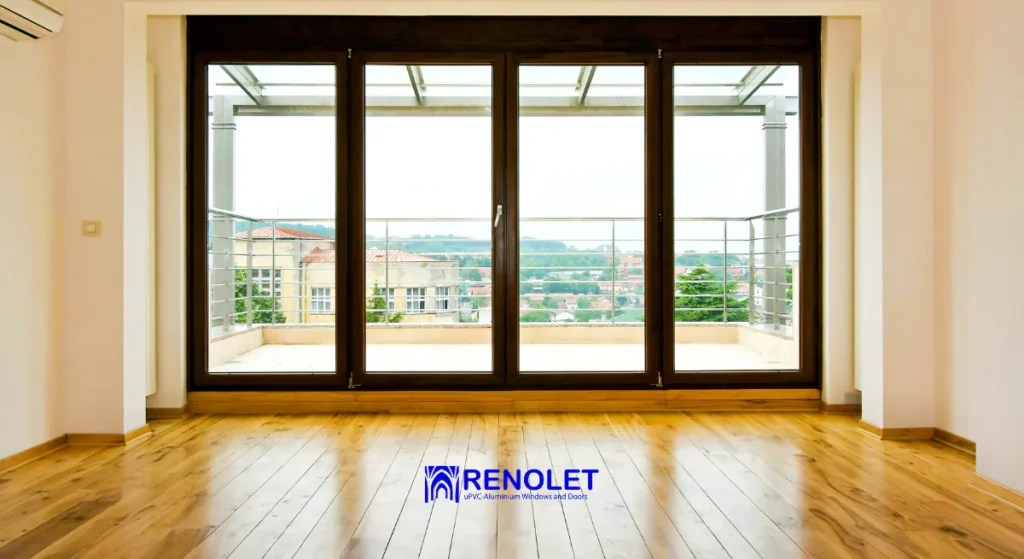
How Do uPVC Openable Doors Improve Energy Efficiency in Homes?
Due to increased electricity rates, and longer duration of using AC, energy efficiency is turning out to become a major priority in Bangalore.
Contemporary uPVC openable doors also have multi chambered profiles which trap air and withhold heat transfer. They are used in combination with either a double-glaze or Low-E glass to boost thermal insulation.
High-performance technically attains U-values of 1.6-2.5 W/m 2K with a double glazing. A lower U-value implies that it is better insulated, which implies that the amount of heat entering in the summer season and cool air getting out will be reduced. For homeowners looking to enhance overall façade performance, pairing doors with high-performance uPVC windows for premium apartments can significantly improve thermal comfort and acoustic insulation across the home envelope.
Why Do Homeowners Prefer uPVC Openable Doors Over Sliding Systems?
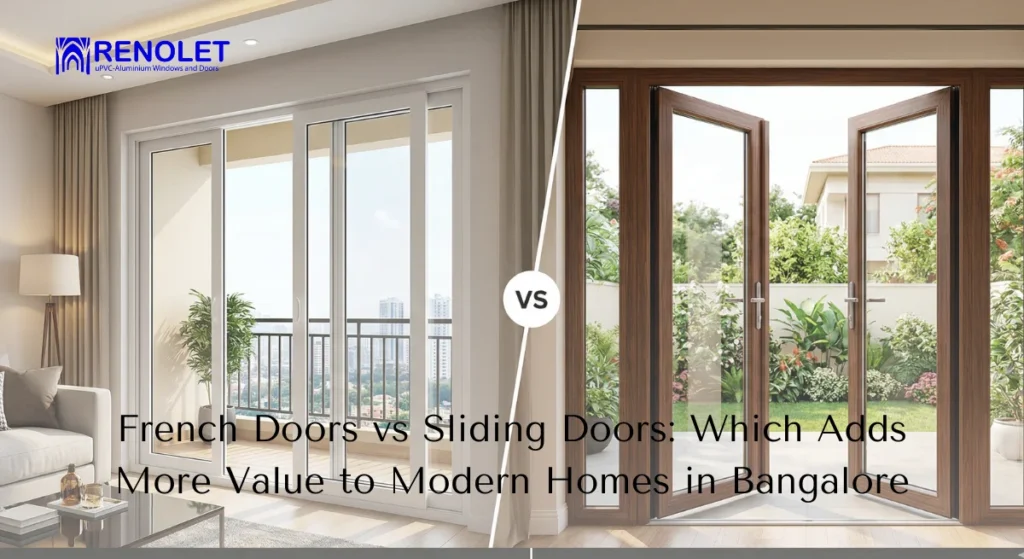
Whereas sliding doors are prevalent, openable designs have better sealing effectiveness. Since the hinged systems close against the frame using compression, they present a strong tighter air and water seal.
This compression is incorporated with multi-point locking systems that will spread pressure over the frame. The outcome is better insulation, higher security and structural stability.
The openable doors also offer greater clearance in opening and easier access to cleaning, which is favourable in the balcony, terraces, garden and kitchen utility spaces
Are uPVC Openable Doors Secure and Long-Lasting?
Urban homeowners are concerned with security. The advanced uPVC systems comprise galvanized steel reinforcement in the profile, which enhances strength and resilience against forced entry.
Further improvement of safety is provided by multi-point locking systems, heavyweight hinges, or toughened or laminated glass. The standard thickness of premium profiles is between 2.5 and 3 mm, which is much more rigid than the low-cost profiles.
However, unlike the wooden doors which are likely to be weakened by moisture or termite infestation, uPVC will last 20-25 years with little care. Occasional lubrication of the hardware and regular cleaning with mild soap is normally adequate. In fact, many homeowners now prefer specialized uPVC doors for bathrooms because they resist swelling, peeling, and fungal damage in humid environments.
What Makes Premium uPVC Openable Doors Stand Out in the Market?
Not every uPVC system has the same performance. Thickness and reinforcement of the profile and hardware integration is important to quality.
High-end brands – like Renolet – distinguish themselves with European-quality engineering, corner welding, extra-thick reinforced profiles, multi-point gasket system, and imported hardware. These systems are highly regulated by international standards and testing benchmarks unlike a center that is entirely geared towards cost minimization.
Instead, the low-cost alternatives might compromise in the thickness of reinforcement, UV stabilization, or locking, which can influence long-term viability.
Selecting certified uPVC openable doors of a reputable brand can be assured of meeting the EN standards and ISO certifications and give a measurable and tested performance.
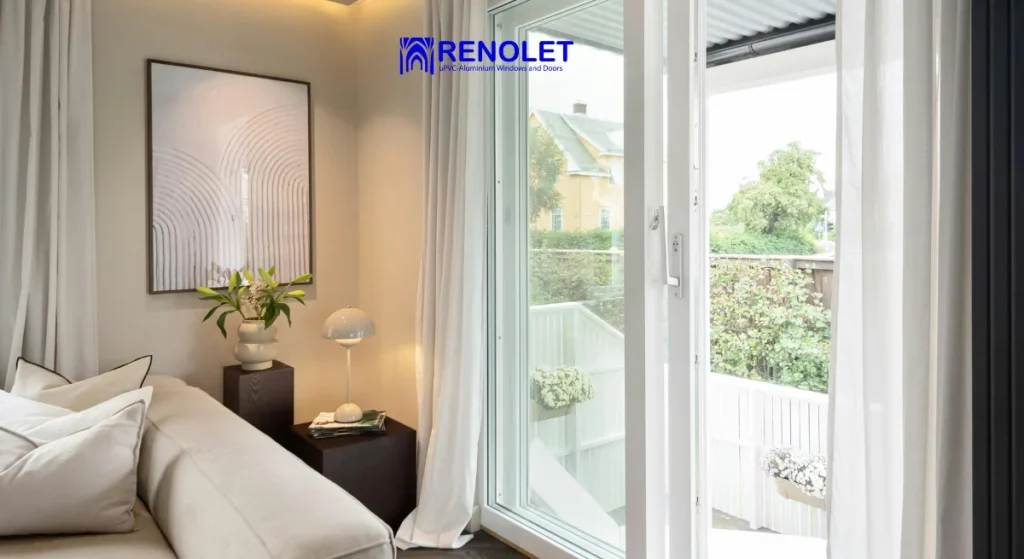
Real Case Study: Whitefield Apartment Upgrade
A 3BHK apartment in Whitefield experienced the same leakage problem throughout the monsoon seasons as a result of warped wooden doors in the balcony. The homeowner substituted them with certified uPVC openable doors with steel-reinforced profiles and double-glazed Low-E glass.
Within one year, the results were evident:
- No water leakage when it is raining heavily.
- Perceptible decrease in noise of the traffic.
- Enhanced indoor cooling conservation.
- No costs of repainting or repair.
The upgrade did not only add comfort to the daily experience, but it also boosted the resale value of the property.
How Do Maintenance and Replacement Costs Compare Over Time?
Parameter | uPVC Openable Doors | Wooden Doors | Aluminium Doors |
Initial Cost | Moderate | Moderate | Moderate |
Repainting/Polishing | None | Every 3–5 years | Occasional |
Termite Treatment | Not Required | Required | Not Required |
Warping Repairs | None | Possible | Rare |
Lifespan | 20–25 years | 10–15 years | 15–20 years |
Conclusion
With nearly 970 mm of annual rainfall, rising urban noise, and increasing high-rise construction, Bangalore homes demand performance-driven materials. The changing home front of Bangalore requires durability, energy saving, security and also low maintenance.
Having excellent performance standards, conformance to the requirements of EN 14351-1 and EN 12608 standards, ISO-certified manufacturing procedures, and a proven application performance with advantages, uPVC openable doors are no longer an option, but rather the choice.
They offer tangible results in limiting the monsoon rains and the amount of noise caused by traffic and also insulation which are measured and technologically verified.

Pingback: Factors Affecting uPVC Door Cost in Bangalore (2026 Guide)