How to Reduce Indoor Humidity in Bangalore Homes During Monsoon?
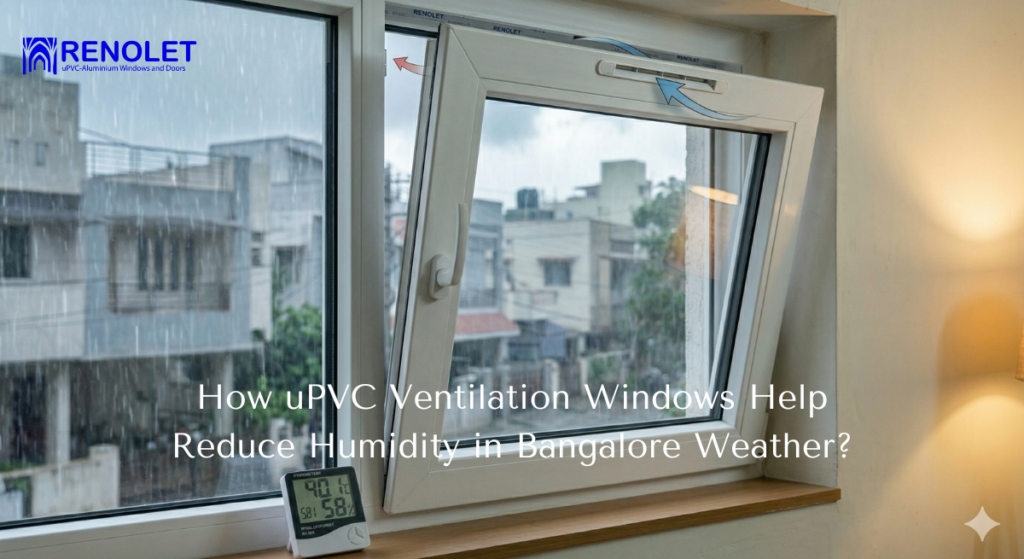
It is not only the air in a Bangalore apartment that is heavy in July. Picture frames in Jayanagar have wall sweat. Whitefield wardrobes grow up mildew on linen forgotten. A hygrometer in a bedroom of Hebbal indicates 84%. On the exterior, the Southwest Monsoon has transformed the city into a terrarium and the windows that are old aluminium sliders and are sealed against the rain have made the situation worse. This is not an issue of one family only. It is the structural humidity crisis in Bangalore that is acting out in silence in lakhs of houses between Yelahanka and Electronic City on each and every monsoon season. The answer lies not in another dehumidifier that is stretched over the overloaded circuit. It is intelligent fenestration, in this instance, uPVC ventilation windows for humidity in Bangalore, which are designed to take into consideration the harsh climate of this city.
Table of Contents
Bangalore's Humidity: A City Outgrowing Its Own Climate
It was in its cool air that Bangalore became the paradise of pensioners. That reputation has eroded. The average relative humidity of Bengaluru currently stands at about 69% per annum, rising to as high as 82% during the Monsoon season peak of 73.8 degrees, and reaching up to 97.2% during the worst seasons. July, August and September with 72-79% humidity levels and 241mm rainfall in September alone will make Indian Climate Monsoon walls and floors always damp due to poor ventilation.
Within the newer apartment complexes of Bangalore, the closed, two-loaded corridors that have now characterized Sarjapur Road and Hennur, there is a worse condition than it would suggest outside. The moisture of cooking, bathrooms and breathing of occupants piles up in the rooms that are not made to breathe. Studies have shown that once the contents of houses such as walls and furniture are wet more than 24-48 hours, mould could grow and airborne causing serious respiratory problems, a trend that has become particularly worrisome in Bangalore where the dampness created by high humidity can fuel the proliferation of mould indoors. Climate That is not a statistic of the large asthma-prone population of the city. It is a monsoon ritual.
Why Aluminium Windows Are Failing Bangalore Homeowners
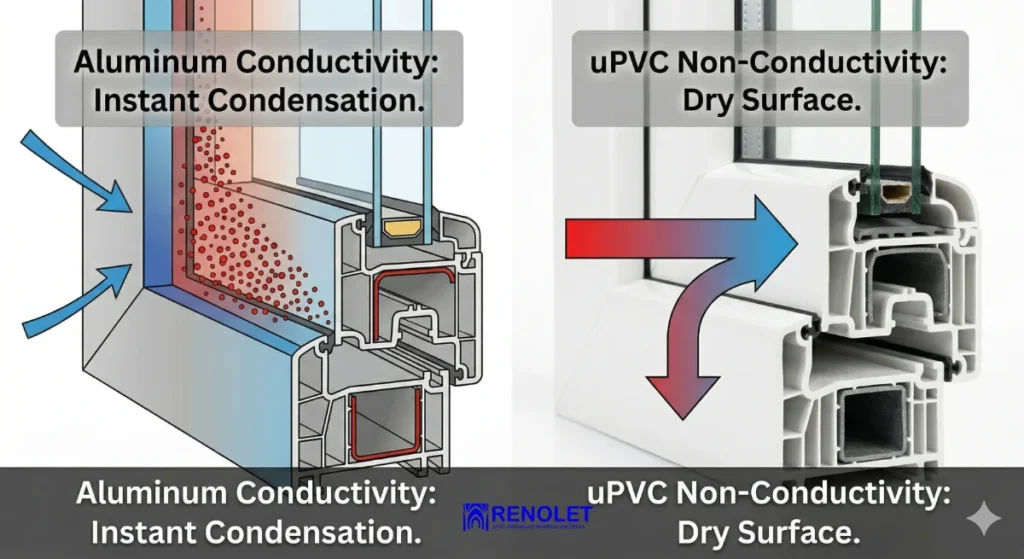
The aluminium sliding windows that have been fitted in the majority of residential stock in Bangalore since the 1990s until the 2010s were not climate intelligent, but cost-effective. Aluminium is free of heat and moisture conductors. At such a time when the air is a hot, monsoon breeze coming into an air-conditioned room in Koramangala or Indiranagar strikes the cold interior face of the frame, it collects as condensate instantly. Water pools in the sill track. After a period of continuous exposure to moisture of 48 hours, mold develops. The sill decays, the plaster stains that lie next, the wall starts to imbibe what the window is dealing unsuccessfully with.
Struggling with persistent humidity during Bangalore’s monsoon?
The Engineering Case for uPVC Ventilation Windows for Humidity in Bangalore
uPVC (Unplasticised Polyvinyl Chloride) is not merely a material replacement, it is a systems-level solution to the moisture problem in Bangalore. Modern designs now integrate insulation and controlled airflow, which is a significant upgrade over older systems. A detailed comparison between uPVC ventilation windows and traditional ventilators explains why conventional solutions fail in high-humidity environments
Thermal Non-Conductivity:
uPVC frames have a thermal conductivity of only 0.1417 W/mKk when compared to aluminium which is 160 W/mK. This heat transfer resistance is almost complete such that the surface of the frame never becomes cold enough to cause condensation even with an AC unit running full blast on a Bangalore July evening. Any laboratory research will testify that properly insulated double-pane windows will permit about 37% relative humidity without any indoor condensation, only 12% with older single-pane conductive frames given the same test. uPVC Magazine.
Trickle Vent Ventilation:
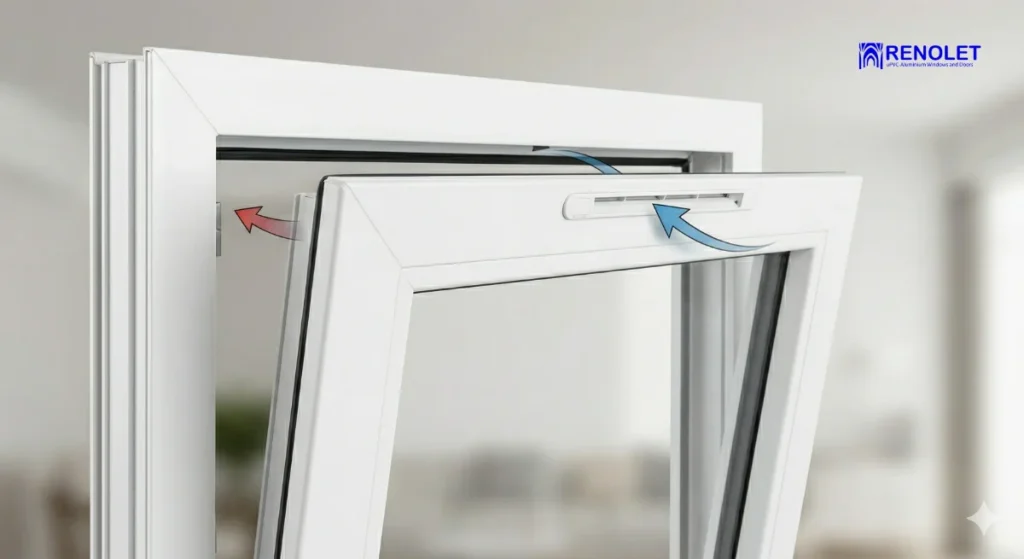
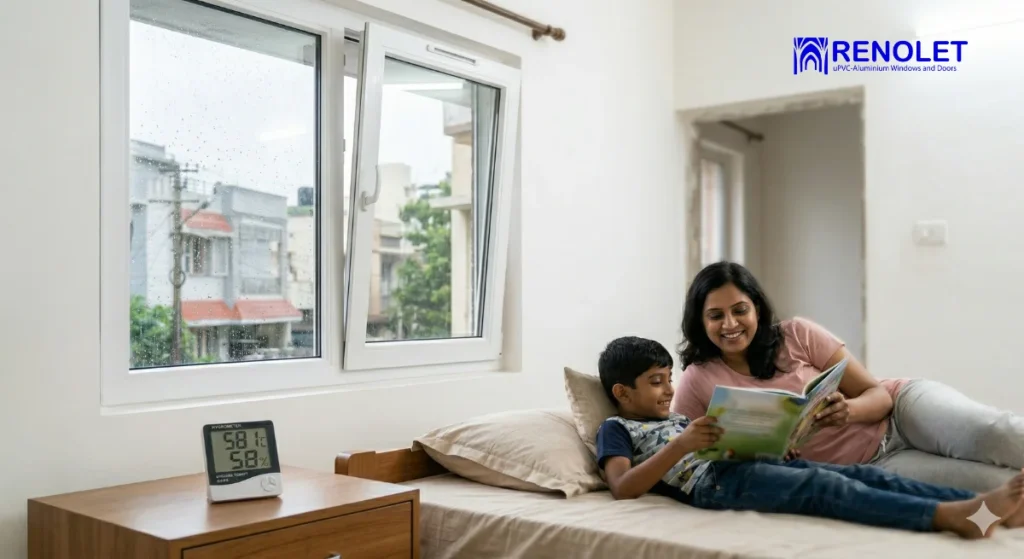
The recent uPVC systems incorporate trickle vents and tilt turn features which enable the fresh air to enter the building without rain access. Good-quality uPVC windows have insulating air pockets in the frames that can avoid cold transfer, are more sophisticated in sealing systems that control air flow without use of draughts, and have trickle vents that are built into the window which offer control over ventilation without the need to open the entire window. This background ventilation is a process of constantly diluting interior moisture, but without mechanical support. Today, uPVC ventilator windows in Bangalore are specifically engineered to handle monsoon-driven humidity while maintaining airflow control and rain protection
Durability:
Quality uPVC profiles made with EPDM gaskets perform well even at 14°C on December nights up to 35°C in April afternoons, and their airtight seals are not lost. UV-stabilised uPVC compounds, which are necessary due to the high solar incidence of Bangalore, are structurally stable over 20-25 years, much longer than aluminium corrodes under conditions of constant high-humidity.
Case Study: A Koramangala Home Retrofit with Renolet
A family in a 3BHK apartment on the 4th floor of a Koramangala complex had battled seasonal humidity damage across three consecutive monsoons. The wall of the master bedroom next to the aluminium sliding window recorded progressive growth of mold every year, by August there was peeling of paint, by September dark spots were spreading. A dust allergy and one child would worsen every monsoon with the symptoms.
Solution:
The family engaged Renolet, a Bangalore-based uPVC window and door specialist with deep expertise in the city’s climate demands. Renolet had indicated a 5-chamber uPVC profile system with trickling vents built-in, EPDM gaskets and double-glazed units in all five openings. The tilt-and-turn system allowed the background ventilation to be controlled during the dry seasons without violating the rain seal of the frame when heavy-cloudbursts hit Bangalore. The installation took three days and did not involve any structural change. The installation was completed within three days without structural modifications, following a streamlined approach similar to the standard uPVC window installation process used in most modern Bangalore homes.
Result:
In the subsequent monsoon period, the relative humidity indoors at 57–62% level was established, the decrease in the relative humidity by more than 25% points compared to its level in the previous year. Mold growth on the master bedroom wall was stopped completely in six weeks. This was the first time in three years that the child experienced no monsoon flare-up of symptoms of allergy. The narrower frame seal also decreased the frequency of AC cycling during the evenings. The retrofit of Renolet paid back its price in the form of less health care expenses, energy savings, etc., in approximately 18 months.
The Future: Why uPVC Ventilation Windows for Humidity in Bangalore Will Become the Standard
Humidity-responsive uPVC ventilation systems are slowly becoming popular in Bangalore’s high-end housing market in areas like Sarjapur Road and Devanahalli. These advanced windows can change airflow based on how much moisture’s in the air inside making homes more comfortable and less damp.
As green building standards like IGBC and GRIHA become widely accepted, good ventilation is no longer just a nice feature, it’s becoming a must-have. In the coming years uPVC systems that are certified to control air and moisture properly are expected to become a requirement in modern homes, in Bangalore.