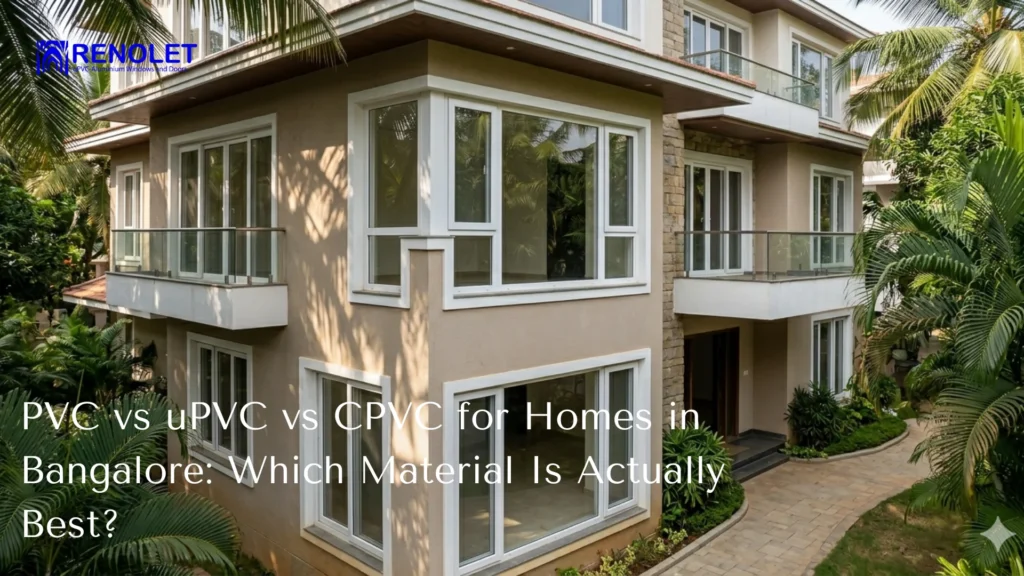
If you’re building a new residence, renovating, or replacing your windows or plumbing pipes in Bangalore, you’ll hear terms like uPVC, CPVC, and PVC.
You will get confused because of the terms, as they all sound very similar. And it can be difficult for you to decide what to purchase.
Many people in Bangalore spent a lot of money on renovations. But when they find out that they have used the wrong material at the wrong place. Sometimes PVC pipes are used for hot water, where CPVC would be the right choice.
As per the BIS specification IS 15778, CPVC pipe made to Indian standards can carry hot water up to 93 °C, whereas standard uPVC pipe can carry hot water only up to 45 °C. Builders tend to use CPVC for hot water instead of uPVC.
Sometimes people also use expensive wood to build window frames that get affected after a few monsoon rains. These types of mistakes might look common, but they often disturb the budget plan.
According to the reports by The Times of India, in Bangalore, many new residential developments are occurring within Whitefield, Sarjapur Road, Electronic City, Yelahanka, Devanahalli & North Bengaluru’s growth corridors. The latest report by the Bangalore Development Authority (BDA) states that over 4,200 residential flats are currently under construction across multiple developments throughout the city.
Homeowners are evaluating the quality of material choices when purchasing new apartments, villas, and plot developments. That is why searches related to building materials, such as PVC vs uPVC vs CPVC, for homes in Bangalore are increasing.
Lets understand through this blog, what to choose between PVC vs uPVC vs CPVC for homes in Bangalore? Which material is suitable for the Bangalore climate? And what is the cost associated with each?
According to a Mordor Intelligence industry report, the Indian uPVC windows and doors market is expected to be worth approximately $1.6 billion by 2026 and grow to $2.27 billion by 2031.
Table of Contents
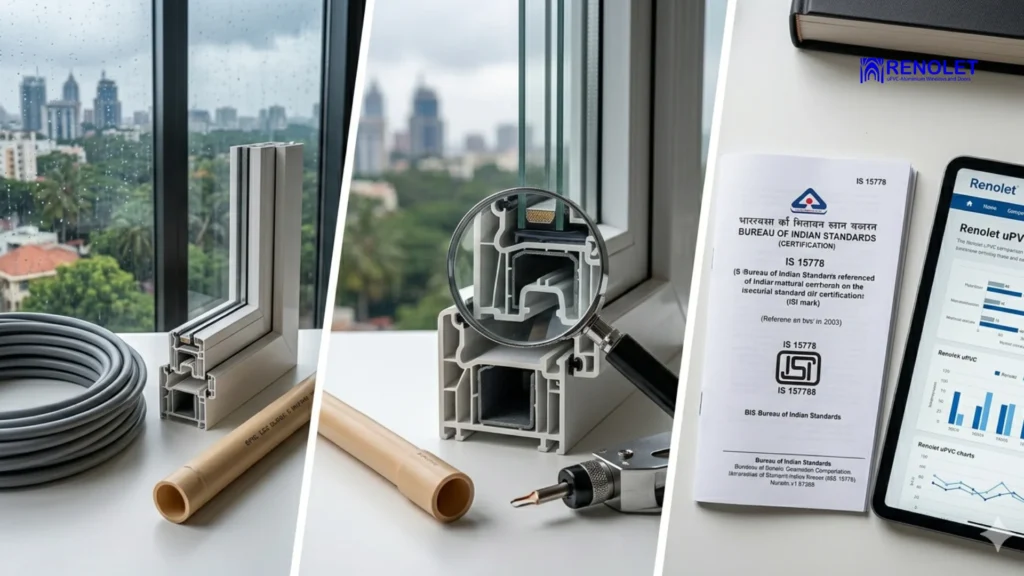
What are PVC, uPVC, and CPVC?
PVC:
The term polyvinyl chloride refers to a type of chemical additive that can be mixed with other materials to enable them to be easily formed or molded into new shapes.
uPVC:
Unplasticized polyvinyl chloride (uPVC) is the name given to polyvinyl chloride (PVC) without the addition of any plasticizer. The primary use of uPVC is in the construction industry, particularly in window and door frames and the external walls of buildings, due to its greater strength than plasticized PVC.
CPVC:
Chlorinated polyvinyl chloride (CPVC) is a variation of PVC in which chlorine is added. When chlorine is added to PVC, the product produced has a higher melting point than regular PVC. CPVC is most commonly used for hot- and cold-water plumbing applications in residential buildings.
Material | Standards | Certifications |
PVC | BIS ISI Mark Certification | |
uPVC | BIS ISI Mark Certification | |
CPVC | BIS ISI Mark Certification (IS 15778), ASTM Compliance Certification. |
The past ten years have seen very strong growth in India’s demand for uPVC products, as homeowners are now looking for materials that require minimal maintenance and offer durability and water resistance. uPVC windows are preferred to wood- or mild-steel-framed windows in Bengaluru apartments and villas due to their ability to resist corrosion, water, and termites.
Get expert guidance on choosing the right windows for your Bangalore home.
Where Each Material Actually Belongs in a Home?
Windows and Doors: Making the Right Choice with uPVC
You might often get confused about uPVC vs PVC windows in Bangalore.
PVC is not strong enough for use in window frames. As temperatures rise and fall, the resulting expansion and contraction is often enough to cause the frame to bend or the joints to become loose.
uPVC is the most suitable material for uPVC windows in Bangalore and doors, given the city’s weather conditions.
There are many advantages of uPVC windows. They are generally unaffected by moisture and do not rust or corrode. It does not transfer heat and cold, making it an effective choice for thermal insulation windows in Bangalore homes.
Plumbing Systems: Why CPVC Is Recommended
Comparison of CPVC pipes vs uPVC pipes in India
uPVC pipes are great for moving cold water and for drainage systems, and they’re strong and low-cost. CPVC pipes are designed to transport hot water. They can withstand heat, making them a typical choice for hydro tanks, solar water heaters, and other hot water systems found in homes.
Bathrooms and kitchens have both hot and cold water supplies. Builders prefer to use CPVC in these applications because CPVC pipe systems can carry water in heated conditions and because of their chemical resistance.
Electrical Conduits: Why PVC Still Dominates
Conduits do not require the same consideration as pipe materials because conduits do not contain pressurized water or have to withstand continuous heat. Because of this, Conduits have become an option due to PVC’s reasonable price, ease of cutting, on-site installation, and ready availability. Electrical Contractors choose to use PVC Conduit.
How Bangalore's Climate Affects Each Material?
Although Bangalore isn’t located on the coast, it does receive rainfall between monsoons. Also, Bangalore has a fair amount of humidity year-round.
The moist winter and dry summer climate causes a gradual degradation of most construction materials over time. PVC performs well when installed underground or within walls, as it is protected from direct sunlight.
uPVC performs well in humid conditions and is considered stable, making it a good option for window and door frames. CPVC has a long service life in plumbing applications because it is installed in sealed pipe systems that insulate it from ambient temperature and moisture fluctuations.
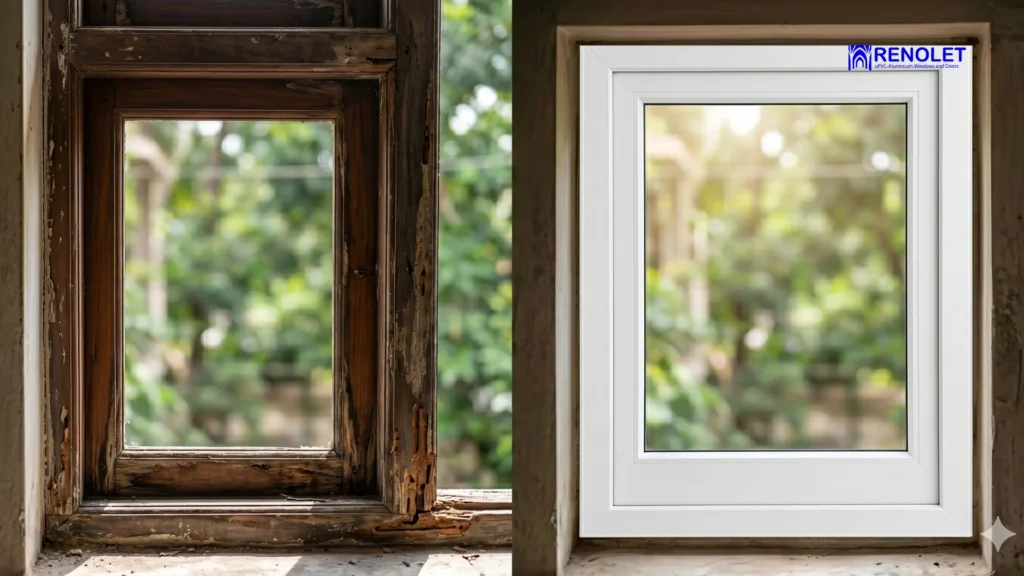
Cost Breakdown of UPVC Windows in Bangalore According to Types
Deepak, a homeowner in Whitefield, has recently renovated his bathrooms and kitchen and used standard PVC pipe during the construction.
He fixed the geyser connection and faced no issue. But when the hot water flowed through the pipe near the geyser, it deformed and bent during the summer months.
After the plumber identified the problem, he noticed that the pipe’s bending is due to the standard PVC pipe, which is designed for continuous hot-water use. So he suggested replacing the pipe with CPVC, which is better as it is designed for hot-water applications.
Deepak paid Rs 3,000 to repair the broken pipes. But if Deepak had chosen CPVC earlier, he would have saved a lot of capital on both the replacement and labor costs.
PVC isn’t a bad product. It needs to be applied properly at the right place.
Cost Comparison: PVC vs uPVC vs CPVC in Bangalore
Initial Material Costs
- PVC pipes are less expensive than any other type of piping.
- uPVC windows are slightly more expensive than some aluminum windows. You can review a detailed cost comparison of uPVC vs aluminium windows in Bangalore before making a decision.
- CPVC pipes generally cost more than regular PVC pipes because they undergo an additional manufacturing process.
Installation Costs
Installing uPVC windows is faster because they are factory-made and require only installation. The use of simple solvent-cement joints allows for faster installation of CPVC pipes than other metal pipes.
Maintenance Costs
Wood windows require regular polishing with termite protection. If you are wondering which is better, uPVC or aluminium?
You may need to paint or re-coat your aluminum windows from time to time. But for uPVC windows, you really only need to clean them occasionally.
uPVC windows and CPVC plumbing pipes can be among the most cost-effective building materials because they usually require fewer repairs and replacements over their lifetime.
Material | Material cost Range (per 1″ pipe) | Installation Cost | Maintenance Cost in 10 to 20 years |
PVC | Rs. 90 – Rs. 130 | Rs. 20- 40 per running ft. | Low–Medium |
uPVC | Rs. 120 – Rs. 150 | Rs. 25-45 per running ft. | Very Low |
CPVC | Rs. 300 – Rs. 420+ | Rs. 35-60 per running ft | Low |
Which Material Is Safest for Drinking Water Pipes?
Using standard PVC pipes as your primary plumbing for drinking water in a modern-day home is not recommended. uPVC is often used in homes throughout India to transport cold drinking water and is considered safe for this application.
When purchasing a CPVC pipe, look for IS 15778 certification. CPVC is the best option for both hot and cold water systems. CPVC can withstand higher temperatures than other materials, and is designed to provide long-lasting performance, making it a safe product for drinking water on an ongoing basis.
Maintenance and Lifespan in Indian Conditions
Material | Typical Lifespan | Maintenance Needs |
PVC | 15 to 20 years | This requires low maintenance with occasional inspection. |
uPVC | 25 to 40 years | This has very low maintenance, with you only needing to clean it frequently. |
CPVC | 25 to 50 years | This is easy to maintain and just requires periodic joint checks. |
Most people don’t understand the difference between PVC and uPVC. So if you buy a house to build it into a home. Once 10 years pass, the costs of maintaining your home could exceed many times the initial investment. Therefore, materials that you normally expect to last at least twenty years with minimal or no maintenance may provide you with greater overall savings. Understanding the lifespan of uPVC windows in Bangalore helps homeowners evaluate long-term maintenance and replacement costs more accurately.
PVC vs uPVC vs CPVC: Side-by-Side Comparison
Feature | PVC | uPVC | CPVC |
Flexibility | They are flexible and bend a little. | They are rigid and do not bend easily. | This is also rigid and strong and cannot be bent. |
Heat resistance | They can handle low temperatures. | It can withstand medium heat. | It can handle high temperatures up to 93°C. |
Drinking water safe | It can be used in limited drinking-water applications. | This can also be used in some applications | This is a safe option to be used in drinking applications and is BIS-certified |
Best use | This is mainly used in drainage pipes and electrical conduits | This is best used for windows and doors. | This is most suitable to be used in hot and cold water applications. |
Bangalore weather performance | This is suitable for the Bangalore climate. | This is an excellent option to be considered for the Bangalore weather. | Best option for the weather. |
Brand Recommendation in Bangalore
CPVC pipes are made from top-quality materials by well-known brands like Ashirvad, Astral, Supreme, and Prince Pipes.
Finolex PVC pipe products are best used for drain, waste, and sewer systems, as well as for electrical conduit systems.
uPVC Windows and Doors Systems by Renolet are designed to suit the climate conditions in Bengaluru. That makes them an ideal choice for new home construction projects or any commercial building requiring window and door systems. Unique features of Renolet uPVC windows and doors are designed to suit the climate conditions in Bengaluru.
Conclusion: Which Is Best for Your Bangalore Home?
If you have understood what to choose between PVC vs uPVC vs CPVC for your homes in Bangalore, you will avoid the mistake of choosing the wrong material. The most important aspect to keep in mind when choosing your materials is to choose according to their use. If you make the right choice, you most likely won’t have to replace it for another 20 years.
Do you still have questions about what is best suited to your home in Bangalore?
Renolet is a reputable brand for uPVC Windows in Bangalore. They’ve served over 10,000 customers in Apartments, Villas, and Commercial Spaces. Their uPVC frames durability in India is designed to maximize thermal insulation and minimize sound transmission.
Replacement of your existing windows with the best window material in Bangalore, uPVC windows from Renolet, is an excellent option for durability and low maintenance.
A quick consultation with Renolet will help you avoid losing money due to an ill-fitted application of a material. We will provide you with an accurate recommendation on what type of windows to install in your home.
till unsure which material is right for your home? Book a free consultation with Renolet.
FAQs
Yes. uPVC windows and doors are much stronger and more stable than PVC. It can bend or lose its shape over time. This makes uPVC a much more reliable choice for window framing applications. It maintains its rigidity under extreme temperature fluctuations and severe weather conditions.
CPVC (Chlorinated PVC) is generally regarded as the best choice for both hot and cold potable water systems, due to its ability to withstand elevated temperatures. It has been certified for the safe delivery of potable water with the Bureau of Indian Standards (IS 15778).
Yes, uPVC is best suited for the Bangalore climate due to the high humidity. uPVC is immune to rust, corrosion, and bending, and that makes it a durable option for all types of buildings.
uPVC windows last longer than aluminium windows, especially in humid conditions, because they do not corrode.