
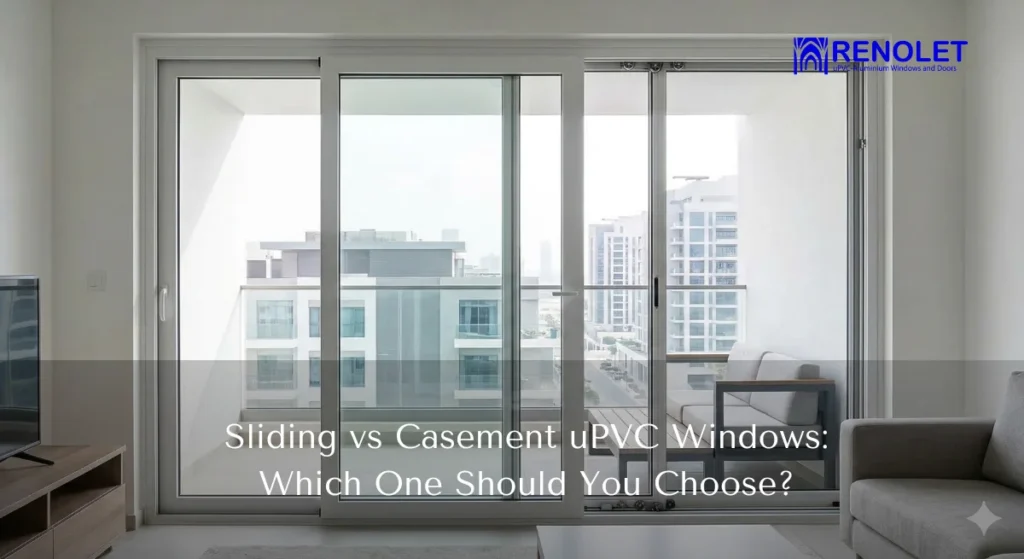
It is the early morning sunlight spreading over a freshly plastered apartment wall with installation crews fitting window frames floor by floor On the outside, there is the traffic clatter, warm air along the facade. On the inside, a homeowner observes two demonstration models, one of them sliding easily on a track, and the other one fitting into place with a soft click. The conversation soon moves out of style to measurable performance. When it comes to modern housing, the issue of sliding vs casement uPVC windows is not a matter of ornament anymore. It is an engineering decision that is guided by certified standards, environmental exposure and long term efficiency objectives.
The current conditions in urban housing require the windows to withstand noise up to 65-85 dB, heat exposure on the facade up to 45-55 C, and higher expectations of saving energy. This renders the performance certifications and standardized testing essential in decision-making.
Table of Contents
What Are Sliding uPVC Windows?
Sliding uPVC windows operate on horizontal rollers wherein the shutters slide in a side-to-side motion along tracks. Their biggest advantage lies in their space efficiency, as they neither project inward nor outward and can be used in small apartments, balconies and in utility spaces.
They also provide extended areas of glass, which enhance the daylight penetration and visual openness. This renders the sliding systems to be a favorite in the contemporary high-rise buildings where the consistency of the facade and modern appeal are essential.
Not sure which window system fits your home? Get expert guidance based on your floor plan, climate exposure, and budget.
What Are Casement uPVC Windows?
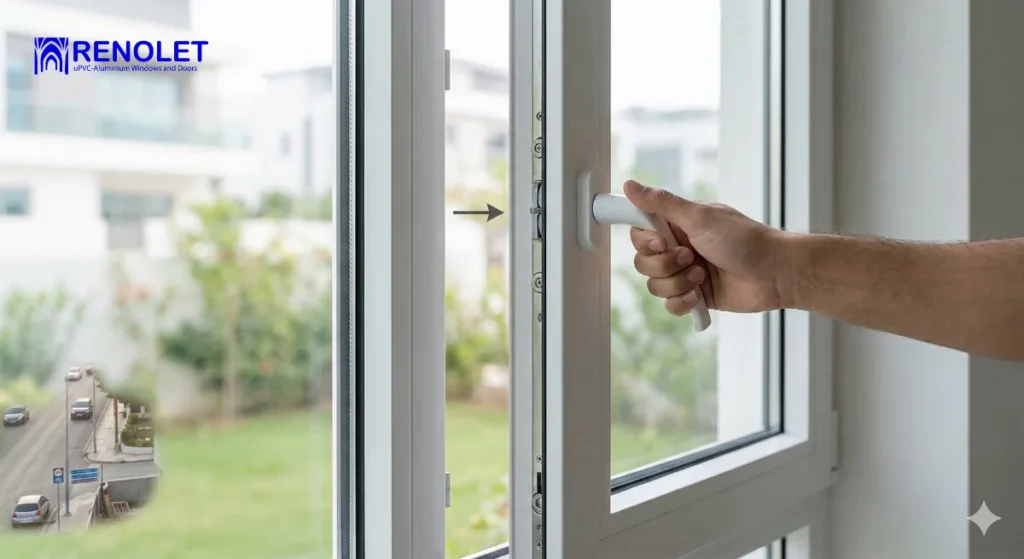
Casement uPVC windows have side hinges that enable the shutter to swing open. When shut, the sash is squeezed into the frame with the multi-point locking systems producing the high standards of airtightness and insulation.
Casement windows are popularly used in bedrooms, living rooms, and villas where the performance of ventilation and the problem of acoustic comfort are important. They are open to 90 degrees or more, therefore, allowing maximum airflow and therefore it is highly effective in passive cooling strategies in warm climates. In urban environments with high traffic noise, selecting the right window system becomes critical. Solutions designed for noise reduction in apartments can significantly improve indoor comfort levels.
Sliding vs Casement uPVC Windows: Key Differences
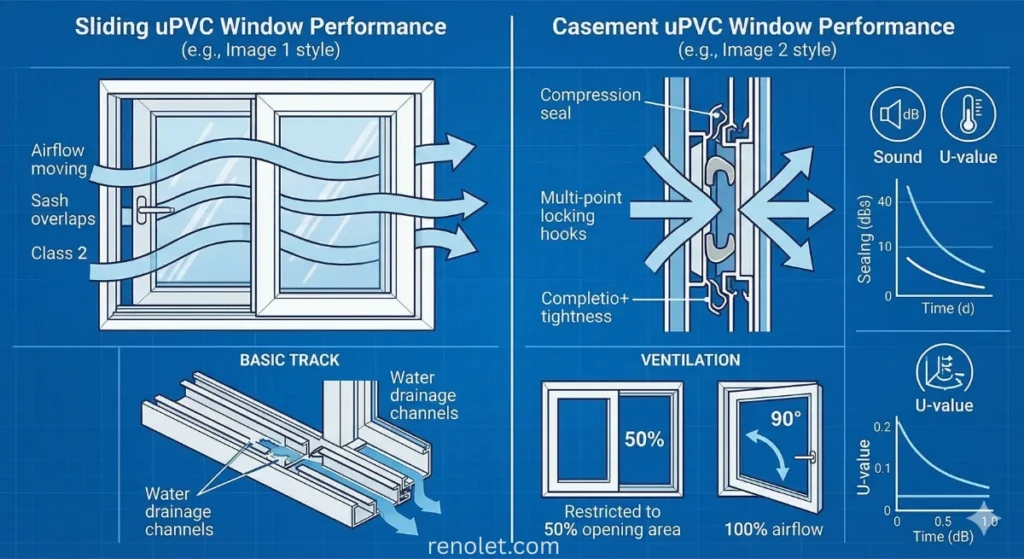
Sliding windows are often chosen for cost and ease, but tests like EN 1026 and ASTM E283 show that casement windows offer better airtightness, insulation, and noise control making a mixed approach more effective. Reference: ASTM E283 – Air Leakage Testing of Windows.
Parameter | Sliding uPVC Windows | Casement uPVC Windows | Recommended Technical Benchmark |
Air Tightness | Moderate sealing due to shutter overlap | High compression sealing with gaskets | Class 2 (Sliding) vs Class 3+ (Casement) |
Water Tightness | Depends on track drainage efficiency | Superior due to tight locking pressure | 150–300 Pa rain resistance recommended |
Wind Load Resistance | Suitable for mid-rise structures | Suitable for high-rise & coastal façades | 1.5–2.5 kPa wind pressure rating |
Acoustic Insulation | 25–30 dB noise reduction | 30–40 dB noise reduction | Urban homes require minimum 30 dB |
Thermal Performance | Moderate insulation due to sliding gaps | Better thermal sealing and energy efficiency | Double glazing can improve U-value by 20–30% |
Ventilation Efficiency | Only 50% opening area | Up to 100% opening area | Critical for passive cooling design |
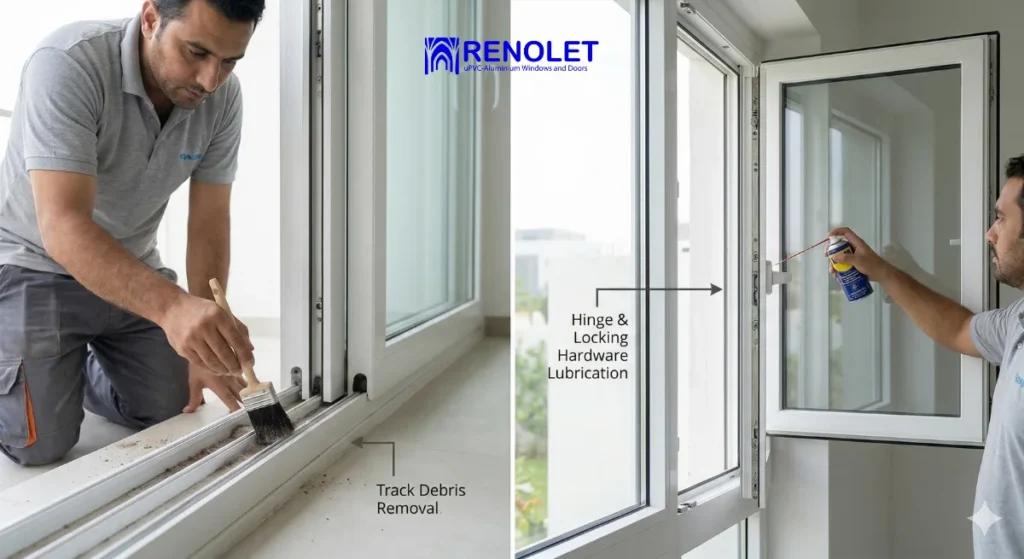
Maintenance Needs | Track cleaning required in dusty areas | Hardware lubrication and hinge checks | Annual preventive maintenance advised |
Space Requirement | No opening clearance needed | Requires internal or external opening space | Design planning consideration |
Sliding vs Casement uPVC Windows: Cost vs Long-Term Value
The sliding windows can typically be less expensive to install due to the simplicity of assembling hardware and less time-consuming installation. However, with the analysis of the lifecycle, it becomes clear that performance-certified casement systems may be more valuable in the long term.
The better casement installations can involve:
- Multi-point locking hardware
- Heavier reinforced profiles
- Advanced sealing gaskets
- Higher-grade glazing options
The energy simulations of the industry indicate that the annual cooling loads can be decreased with the help of high-performance casement windows used on heat-exposed facades by 8-12% each year. A detailed breakdown of uPVC window costs in Bangalore can help homeowners make informed decisions.
Why Window Certifications Matter?
Globally, window systems are tested using standardized performance tests which determine air leakage, water penetration, wind resistance, and structural durability. The certifications assist architects and developers in assuring that the window installations are of minimum comfort and safety requirements.
Some of the most frequently mentioned certification models are:
- EN 1026 / EN 1027 / EN 12211 – European standards of test on air permeability, water tightness and wind load resistance.
- BS 6375- British performance standard concerning weather resistance.
- ASTM E283 / ASTM E331- Air infiltration and water penetration performance simulation benchmarks.
ISO 10077– Thermal transmittance ( U -value ) testing of window assembly.
Real Project Insight: Performance Recalibration in a Residential Tower
Problem:
Sliding uPVC windows were first used in the entire building of a residential high-rise in an emerging technological-focused urban center to provide uniformity on the facade. Subsequent simulation of the performance indicated the noise levels were more than 70 dB in the west-facing houses and greater heat gain during afternoons, which had an impact on the indoor comfort.
Solution:
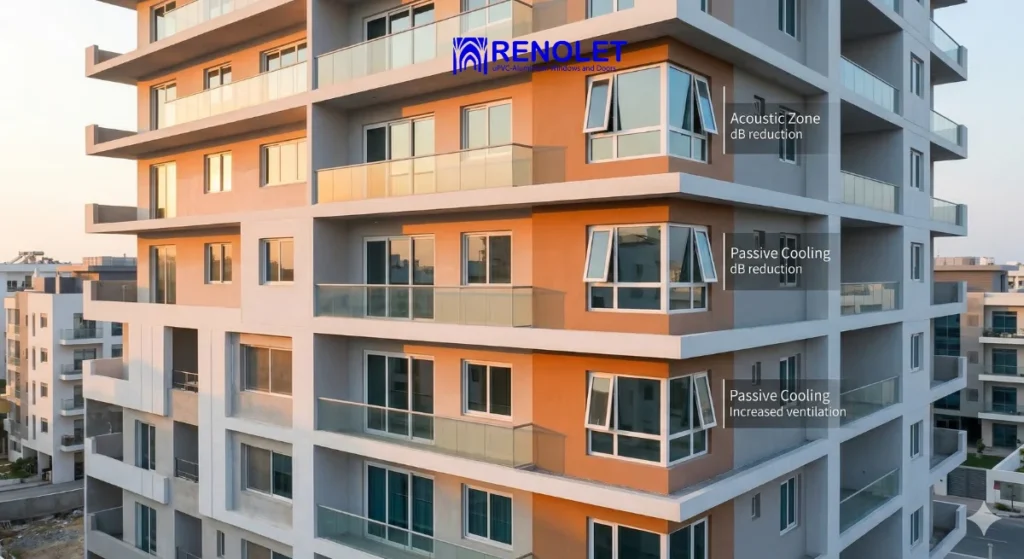
Incorporating contributions of an engineering-based uPVC architecture label such as Renolet, developers revised the window design by fitting performance-rated casement windows with improved air-tightness and heavyweight profiles in bedrooms and in the living rooms, but continue to use sliding windows in the balconies.
Result:
As per the residents, the thermal comfort, reduction of AC usage in mild seasons, and noise insulation at night were improved, which demonstrates the importance of performance-based planning in windows.
Ventilation, Energy Efficiency, and Indoor Comfort
The casement windows are more conducive to cross-ventilation and air circulation, and therefore, they aid in cutting down on the reliance on the mechanical cooling systems in warm regions. Their broader apertures also add to an enhanced air quality and thermal comfort in the house.
On the other hand, sliding windows are suitable in space constrained designs and the modern facade, they have broader glass views and they are easy to operate. They can also be designed to meet the safety and insulation requirements of high-rise with the appropriate glazing specifications.
The current energy performance planning process also puts emphasis on window to wall ratio, shading, and glazing mix and so window arrangement is becoming one of the major determinants of the total building efficiency. Improved sealing and glazing can also reduce cooling loads, contributing to lower electricity consumption over time.
Sliding vs Casement uPVC Windows: Which One Should You Choose?
| If You Need | Choose |
|---|---|
| Space saving | Sliding |
| Better insulation | Casement |
| Noise reduction | Casement |
| Large glass views | Sliding |
| Energy efficiency | Casement |
Conclusion
Whether to use sliding or casement uPVC windows ultimately relies on the space, exposure to the environment and long term comfort concerns. Sliding windows are efficient in small designs and modern designs, whereas casement ones are more efficient in high-exposure locations in terms of ventilation, insulation, and energy.
In the case of most present-day households and residential projects, a compromise between the two systems, i.e. one system in the rooms and in the front the home faces, offers the most appropriate balance between performance, efficiency, and design flexibility.

Khelovipapp, eh? I downloaded it, and it’s pretty sweet. Easy to use, and it does what it says on the tin. Give it a download! khelovipapp